

Financial briefing · 2026
Macro Brief
A cheaper Bloomberg for data analysts — hedge funds, family offices, or someone running their own book. Calendar, sources, and a readable brief. Honest about what it is not: a live terminal.
- Surfaces
- Desk + reader
- Users
- Analysts / PMs
- Vs terminal
- Less live tape
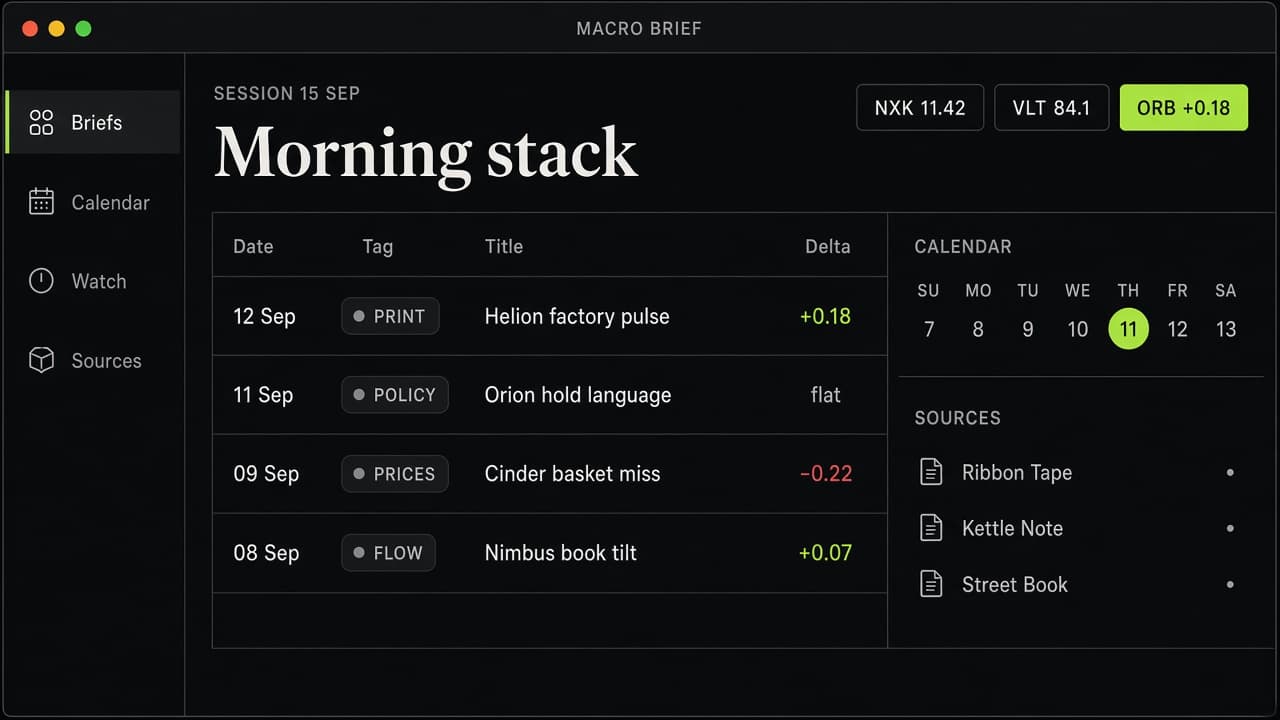
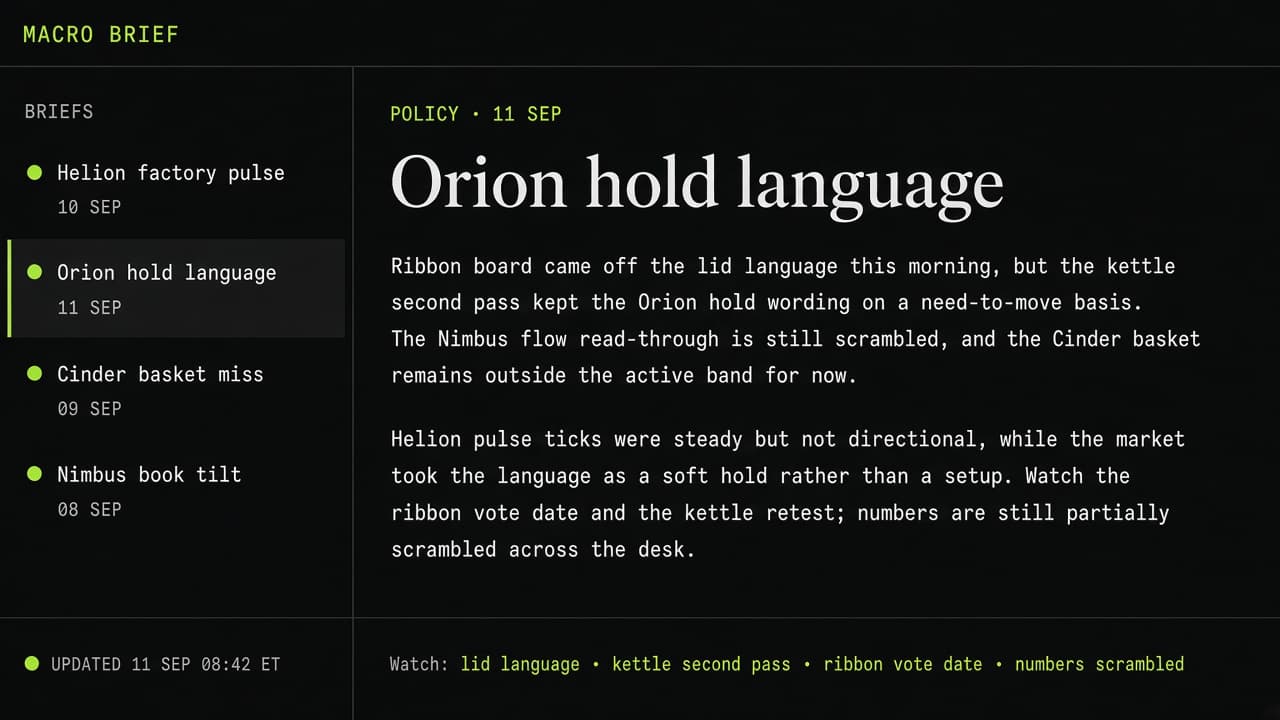
Product shape · data scrambled
Session
Morning stack
Policy · 11 Sep
Orion hold language
Ribbon board kept the lid on the kettle. Guidance stayed fogged. Street books had priced a hinge that did not arrive. We mark the tape as a shrug, not a turn — Nimbus flow still leans the same way, Cinder basket stays noisy, Helion pulse is one print not a path.
Watch: lid language, kettle second pass, ribbon vote date. Numbers on this screen are scrambled. They are not a live book.
Problem
Bloomberg and a wall of terminals can show that the market exists. They do not write the morning. Analysts still wake up to tabs, chat dumps, and a calendar in a different window. The useful sentence is never on the same page as the date it belongs to. Existing tools fail the open: can you trust one brief in ten minutes, or are you reconstructing the night from a blotter and Slack?
Outcome
The desk opens on a dated note — what moved, why it matters, what to watch — with calendar, sources, and a watch strip in the same login. It is cheaper than a full terminal because it does less live tape. I do not pretend the prints are as current as Bloomberg. The public screens are scrambled. They are not a live book.
The operational problem
A terminal proves the print happened. It does not prove which sentence still matters at 7am. Chat can hold a useful line and bury it. A PDF from yesterday cannot tell you whether the calendar still agrees with the watchlist. Data analysts at funds, family offices, and one-person books were paying for a firehose and then writing the actual brief in a third place. I built Macro Brief because the bottleneck was the handoff, not access to another live pane.
What Macro Brief does
Two surfaces, one record. The desk is the working board — briefs, calendar, watch, and sources. Each row is a dated note with a type (print, policy, prices, flow) and a move, not a bookmark. The reader is the published page: a framed argument, the watch items that still matter, and what to look at next. The analyst writes. The product keeps the date honest so yesterday’s note does not drift into a scrapbook.
A cheaper Bloomberg — on purpose
The honest comparison is the one I will say in the room. Macro Brief is a cheaper Bloomberg for the morning stack: calendar, sources, a readable brief. It is not a knock-off of the live terminal. The tape here is less up to date than Bloomberg, and that is the point — you are not paying terminal money for a second blinking book. You are paying for a desk that turns overnight work into one page a PM can finish. If you need every tick, keep the terminal. If you need the argument, open this.
Built as a private desk
This is a logged-in workspace for a fund, a family office, or a book you run yourself. The live book never sits on the marketing host. Sessions expire. I do not publish the real calendar, the real pairs, or the real prints. A public copy of the book would be a gift to anyone who wants the same morning without the work.
Why the public page stays fogged
The screenshots on this page are the shape of the product. Labels, prints, and pairs are invented. They are not a live book. If you recognise a ticker or a factory name, you are reading scramble on purpose.
Your project
Need something with this level of thought behind it?
Next
HACCP Hacker →